
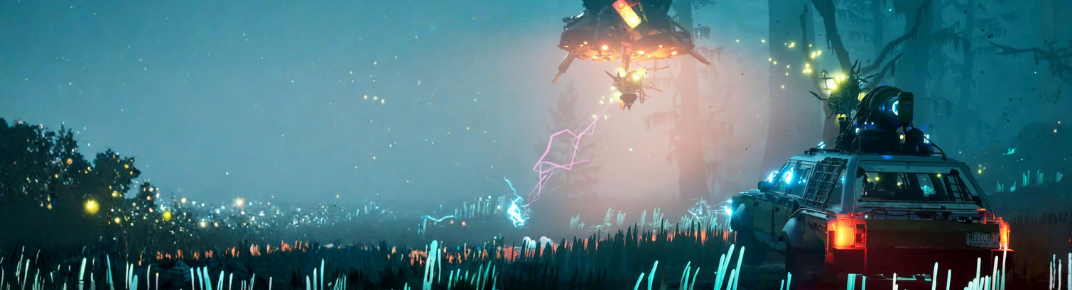
Most survival games eventually give you a safe place.
A cabin. A campfire. A fenced-off base. Some little digital burrow you can crawl back into when your pockets are full of mushrooms, scrap metal, raw meat and bad decisions.
Pacific Drive looks at you differently.
Here, your base has wheels.
You are not playing a hero who casually punches his way through the end of the world. You are a driver stuck in a battered station wagon, trying to survive inside the Olympic Exclusion Zone. And this zone is not just a dangerous area. It feels more like someone locked all of reality’s corrupted files inside a forest, then waited decades before checking what they had become.
On paper, Pacific Drive is a first-person driving survival game. You drive, scavenge, repair, upgrade and try to make it back to the garage. In practice, it becomes much more personal. You have a car, and after a while you stop thinking of it as “the vehicle”. It becomes the old thing that somehow keeps dragging you back alive.
That is the game’s best trick.
It does not give you a human companion. No talking robot, no loyal dog, no radio buddy dropping jokes every three minutes. You get a rough, wood-paneled station wagon. Doors, panels, tires, hood, battery, headlights, fuel. Parts that can break one by one, and eventually you start watching them the way you would watch a health bar in another game.
Because here, the car is the health bar.
If a door gets ripped off, you did not just lose a part. You lost a piece of safety. If the headlights die, the entire forest moves closer. If the fuel runs low, the map stops looking like an adventure and starts looking like a mistake. And when some strange electrical anomaly shakes the car and the dashboard lights up like it has seen something it should not have seen, Pacific Drive reminds you that a game does not need to show a monster to make silence uncomfortable.
The structure is built around runs. You head into the zone, scavenge, dismantle, explore, panic, pray, and then try to return to the garage. The garage is the game’s bloodstream. That is where you repair, upgrade and tape the end of the world back onto the side of your car. It is not a shiny high-tech headquarters. It is an oily shelter where every return feels earned.
That is why it fits Survival Monday so well.
Pacific Drive is not tense because every bush hides a wolf. It does not constantly nag you with hunger, thirst, poison, freezing temperatures and a spreadsheet of misery. Its fear is simpler and more human: what if you went too far? What if you should not have taken that detour? What if the next junction is not a shortcut, but the point where the zone decides to keep you?
The game understands pacing. The roads are not just levels. They are temporary expeditions. Every trip becomes its own little survival story. Sometimes you creep forward carefully. Sometimes you floor it because panic has taken the wheel. Sometimes you stop beside a wreck because you need the parts, even though everything in your body says this is a bad idea. One of Pacific Drive’s strongest moments is when nothing obvious happens. You stand by the roadside, hear the radio crackle, stare between the trees, and still feel that something has already noticed you.
The environment is not set dressing. The zone is full of anomalies, strange phenomena and hazards that do not always behave like ordinary video game enemies. This is not an arena. It is not a traditional open world either. It is more like a hostile travel diary, one you write yourself, except sometimes the page bites back.
Upgrading the car is not just number-padding either. It is not about adding three percent resistance and five percent protection, then moving on. Better panels, new equipment, extra fuel, stronger parts, they all matter outside the menu. You feel them on the road. A new tire, a sturdier door, one more tank of fuel can be the difference between rolling back into the garage and becoming one more thing the zone quietly keeps between the trees.
And the garage itself deserves credit. Few games sell the feeling of coming home this well. It is not heroic. There is no confetti, no grand musical swell. You just pull in, kill the engine and look at what the road did to you. A dented door, a broken light, a smoking hood can tell more of a story than a thirty-minute cutscene.
Pacific Drive has also grown since launch. The Whispers in the Woods expansion added new story content, a new area and a strange group built around the anomalies. It fits the base game perfectly, because Pacific Drive has always understood that the unknown does not need to scream. Sometimes it whispers from the woods, and you still start the engine.
It is also in a much better place platform-wise now. The game launched on PlayStation 5 and PC, then later arrived on Xbox Series X|S and appeared on Game Pass. That matters, because Pacific Drive is the kind of game that can be hard to sell through a trailer alone. It looks interesting, sure. It has atmosphere. But it truly clicks the first time you crawl back into the garage with the car half-destroyed, and somehow feel proud of it.
It is not a perfect game, but that almost suits it. There is some clunkiness, some stubborn systems, some fiddling around. But a game that turns a beaten-up station wagon into your best friend would feel wrong if every movement was sterile and polished. This is not a luxury car simulator. This is survival held together with duct tape, gasoline fumes and the quiet feeling that the next road is probably one road too many.
And then you go anyway.
That is what Pacific Drive does to you. It does not push you forward with speeches. It does not call you a hero. It simply opens one more road, one more zone, one more risky detour. You look at the car, hear the engine cough, and with a stupid amount of trust you say: fine, one last run.
Then the road gives its answer.
SURVIVAL MONDAY METER
Survival Monday score: 9 / 10
Survival factor: 9/10
The real question is not just whether your character survives. It is whether your car does. That turns every route into its own little risk calculation.
Atmosphere: 10/10
Rain, forest, radio noise, broken headlights, zone anomalies. Pacific Drive does not jump at you. It slowly closes the door behind you.
Originality: 9/10
There are plenty of survival games. There are far fewer where you start caring about a station wagon more than yourself.


 Marci
Marci
What do you think? Share with us.
Comment section
Hozzászóláshoz vagy kommenteléshez jelentkezz be, vagy ha még nem vagy tagunk, regisztrálj.
News
Az Abiotic Factor azt bizonyítja, hogy nem kell erdő, sivatag vagy zombihorda ahhoz, hogy az ember p ...
A Once Human posztapokalipszise nem a szürke romokkal akar nyomasztani, hanem azzal, hogy a valóság ...